Friday, 4 October 2013

Visual Poetry event (8/10)

Professor Terri Witek (Sullivan Chair in Creative Writing at Stetson University, US) and Cyriaco Lopes

Special Event at Salford Museum and Art Gallery

Professor Terri Witek  and new media artist Cyriaco Lopes present their collaborative visual poetry at the North Gallery in Salford Museum & Art Gallery Tuesday 8th October 3pm (free entry).
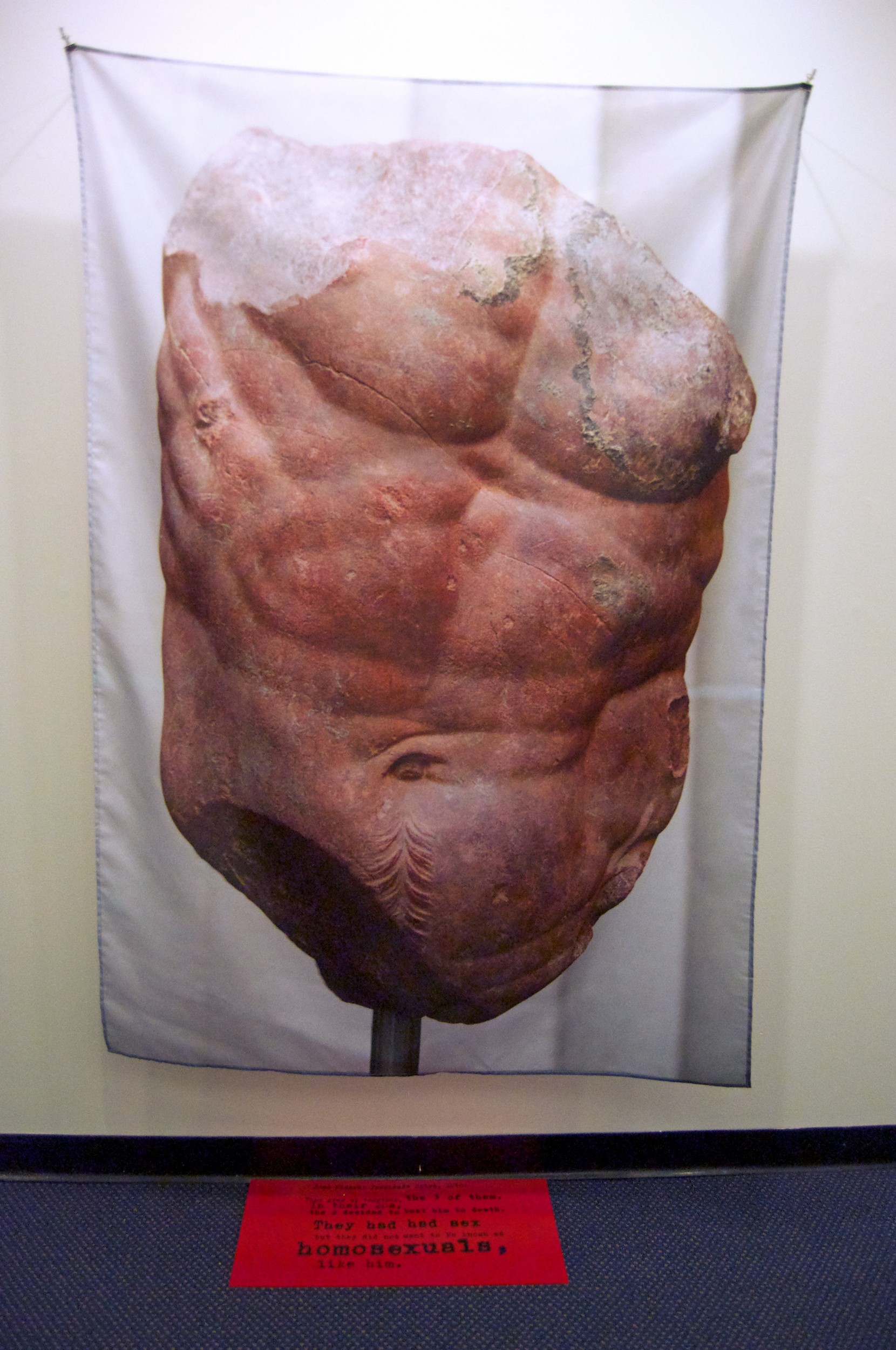


Terri Witek and Cyriaco Lopes have been collaborating since 2005. While Witek often writes poetry about art, Lopes’ art work often investigates language. A signature of their collaborations is that their media, art and poetry, interweave while each retains its identity. By reinventing, interrupting and restaging each other’s words and images, they create a hybrid third possibility. Their collaborations so far have extended to video, performance, photography, drawing, and artists’ books. Their projects have been featured at Art in Odd Places (Big Bronze Statues was chosen as one of the highlights of the 2009 season by Time Out New York), in a solo show at Le Petit Versailles, New York, at the British Film Festival (finalist in the avant-garde category), and in Contemporary Flanerie: Reconfiguring Cities (Oakland University, Michigan) among other venues. The first retrospective of their work to date, but here all dreams equal distance, was shown at Grinnell College’s Faulconer Gallery in April, 2010 and featured a collaborative multi-media event, the day you left. In November 2010 their site-specific project, A Shelter on King’s Road placed the trace of Martin Luther King’s firebombed cottage in the Markland House, a National Register treasure acquired by Flagler College in 1966. Current projects include All Love is Stolen (2013), a 5000 flyer street distribution in South Beach for O, Miami, and The Fernando Pessoa Game, which they ran in Lisbon in the summer of 2013.

The Salford Lectures: Professorial Inaugural Series

Professor Alan Williams


Date: Wednesday 30 October 2013
Time: 5.30pm
Venue: The Council Chamber, The Old Fire Station


We are delighted to invite you to the first of this year’s Professorial Inaugural Lectures which will be delivered by Professor Alan Williams on Wednesday 30th October, commencing at 5.30pm in the Council Chamber at The Old Fire Station.
Professor Williams has been at the University of Salford since 1995 and is currently Professor of Collaborative Composition within the School of Arts and Media.
The lecture, entitled ‘Out of the Garret – the Composer as Collaborator’, will discuss the historical role of the composer and how social and technological changes have transformed the relationships involved in the creation of music. You’ll hear some music in which Professor Williams has taken a part in creating over the last 5 years, and details of future projects in which the audience has a hand in the creation of the work.
This is a free event as part of our public series of lectures, which are open to all. Please register your attendance via our website, or alternatively reserve a place by contacting the Events Team on 0161 295 5275 or events@salford.ac.uk.

Friday, 27 September 2013

University of Salford Media Festival -- 19/20 Nov


We are proud to announce the following participants at the two main days of the festival (19th-20th November). More speakers are being confirmed on a regular basis so watch this space…
Festival Chair: Steve Hewlett (Writer and Broadcaster)
Confirmed speakers:
  • Fiona Hyslop MSP, Cabinet Secretary for Culture & External Affairs in the Scottish Government
  • Josh Weinstein, American Writer and Producer, Writer for 'The Simpsons'
  • Stuart Cosgrove, Director of Creative Diversity, Channel 4
  • Dan McGolpin, Head of Scheduling and Planning, BBC One
  • Andy Culpin, Managing Director, 12 Yard productions
  • Victoria Jaye, Head of BBC Television Content Online and IPTV
  • Simon Egan, Managing Director, Bedlam Productions
  • Crispin Simon, Managing Director, Trade Development, UK Trade and Investment
  • Simon Hirst, Capital FM, Yorkshire
  • Mike Beale, Director of International Formats, ITV Studios
  • Timo Vuorensola, Film Director of, among others, Star Wreck and Iron Sky
  • David Liddlement, BBC Trustee
  • John Wiston, Creative Director, Serial Dramas, ITV Studios
  • Lucy West, Head of News, Granada Reports
  • Alex Gardiner, Director of Factual, ITV Studios
  • Nick Curwin, Chief Executive, The Garden
  • Simon Pitts, Director of Technology and Transformations, ITV plc
  • Hasraf Dulull, Visual Effects Supervisor and Director  known for The Dark Knight, Prince of Persia, Hellboy II, The Chronicles of Narnia: PrinceCaspian
  • Justin Weyers, Animation Producer, A Liar's Autobiogrpahy: The Untrue Story of Monty Python's Graham Chapman
  • Scott Martin, Development Producer, CBBC 
  • Leslie Woodhead, Award winning Documentary Filmmaker, How the Beatles Rocked the Kremlin, The Hunt for Bin Laden, 9/11: The Day That Changed The World
  • Cat Lewis, CEO and Executive Producer, Nine Lives Media
  • Katy Jones, Executive Producer, BBC Learning


Full info here: http://salfordmediafestival.co.uk/

Manchester Uni talks

University of Manchester – Drama Seminar Series
CULTIVATING RESEARCH
Autumn 2013

1. “Performing the Psychology of Imprisonment: Revisiting Stanford”
Thursday 10th October, 5.00pm-6.30pm - Martin Harris Centre, SL01
Stephen Bottoms (Professor of Theatre & Performance, University of Manchester) with guests including Simon Ruding (Director, Theatre in Prisons & Probation).

The Stanford Prison Experiment of 1971 is one of the most celebrated case studies in the history of social psychology, not least because of its extensive cultural ‘impact’ beyond the academy. Yet the experiment conducted in a small basement area in Stanford University’s Psychology department was essentially a long-form role-playing exercise – a piece of improvised theatre. Questions have long been asked about the generalizability of its findings, in psychological terms, but this performative presentation instead considers the specificity of site and players, viewing the SPE as a landmark piece of performance art.

2. “On site: making and marking”
Thursday 14th November, 5.00pm-6.30pm - Martin Harris Centre, SL01
Mike Pearson (Professor of Performance Studies, Aberystwyth University), with respondent Julian Thomas (Professor of Archeology, University of Manchester) 


In this illustrated seminar, Mike Pearson draws together the experience of directing two large-scale theatre productions for National Theatre Wales – Aeschylus’s The Persians (2010) and Shakespeare’s Coriolanus (2012) – with critical approaches from his recently published book Marking Time: Performance, Archaeology and the City (University of Exeter Press, 2013). He suggests ways in which thinking archaeologically might extend and enhance both the creation and apprehension of site-specific performance; and how thinking performatively might inform understandings of archeological formation processes and sites.

3. Visual Dialogues: “The Radical Middle Way”
Thursday 5th December, 6.00pm-7.30pm - John Casken Lecture Theatre
Screening with Q&A (speakers to be confirmed). Convenor: Dr. Johannes Sjoberg.

Founded in the wake of the 7/7 attacks on the London underground, The Radical Middle Way promotes a mainstream, moderate understanding of Islam that young people can relate to. This special screening and Q&A will draw on Radical Middle Way filmmaking, in exploring what it means to believe, in the 21st century. www.cargocollective.com/radicalfilms

Thursday, 26 September 2013

Talks at WCML

9 October
David Wilkinson "I read Nietzsche at fifteen": The Fall's Mark E. Smith and other working class autodidacts on the Manchester post-punk scene
An offbeat examination of class, education, cultural influences and politics on post-punk Manchester, taking in 'weird fiction', pagan feminism and public libraries amongst other topics.

23 October
Deborah Mutch Hidden between the pages: British socialist fiction, 1884-1914
The founders of British socialism recognised the importance of the written word in the promotion of their cause and published prolifically: books, pamphlets, tracts, lectures, sermons and other forms of written publicity. One of the most popular forms of written communication was the weekly or monthly periodical 
which was published by almost every socialist group or faction. The use and proliferation of these periodicals has been studied and appreciated by historians but the fiction carried by almost all of the periodicals has largely been overlooked. This talk will uncover some of the many forms of fiction used by activists in their desire to create a socialist society.

Full info: http://www.wcml.org.uk/events/invisible-histories-talks-autumn-2013/

Tuesday, 24 September 2013

Talks at MMU


You are warmly invited to our Autumn term seminars on the Philosophy of Film in the Department of Media, on Monday 30 September, 4:00 – 6:30PM

4pm. Joe Duffy (Film, Manchester Metropolitan) : Performative Traces of a Traumatic Place
 
5pm. Robert Sinnerbrink (Philosophy, Macquarie University): Cinematic Ethics: Film as a Medium of Ethical Experience

Department of Media, Manchester School of Art, 30 September 2013

Room 308 NAD building
Manchester Metropolitan University,
All Saints
Manchester, M15 6BG (next door to the Salutation pub)


Please use the Boundary Street West / Higher Ormond Street entrance for the Manchester School of Art main reception in the New Art School (NAD) Building http://www.artdes.mmu.ac.uk/about/contactus/

http://www.artdes.mmu.ac.uk/courses/prospectus/#/page/1

Any enquiries, and if you would like to join us for dinner afterwards,
please contact Felicity Colman f.colman@mmu.ac.uk

Monday, 23 September 2013

Events at York St John University

Astrid Schmetterling:
Friday 4th October at 3.15pm, Quad South Hall.  
Astrid is a Senior Lecturer in Visual Cultures at Goldsmiths, University of London and is offering a Lecture on Uriel Orlow’s unmade film: A Multidirectional Archive for Palestinian and Israeli Traumatic Memory. More information and booking:  https://www.eventbrite.co.uk/event/8384184321

Arnold Dreyblatt  
Friday 4th October Quad South Hall. 4.30pm
Arnold Dreyblatt is an American media artist and composer based in Berlin. Arnold will deliver a presentation on the recent residency undertaken at the Norwegian Theatre Academy involving the use of public display spaces in Fredrikstad to function as public interactive platform for meetings, performance and installations. More information and booking: https://www.eventbrite.co.uk/event/8319450701

Sxip Shirey: Friday 4th October at 9.30pm. The Basement Bar at City Screen, Coney Street York. Gene "Sxip" Shirey is an American electric-acoustic composer, performer, and story-teller. He will perform a one man show of sonic stories. Using original sounds, Shirey draws from a range of sonic memories, experiences and janky beats to conjure up this evening of live works. More information and booking https://www.eventbrite.co.uk/event/8349151537


Trevor Wishart: Saturday 5th October Temple Hall 12.00 pm (arrive 15 minutes early).
Trevor Wishart presents: Encounters in the Republic of Heaven. Saturday 5th October at York St John University, space: Temple Hall 12.00 pm (arrive 15 minutes early).
Encounters in the Republic of Heaven is an 8-channel sound-surround piece based on speaking voices recorded in the North East of England. More information and booking: https://www.eventbrite.co.uk/event/8349191657


Professor Petra Maria Meyer  
Saturday 5th October 5.45 pm beginning in Quad south Hall and moving into Temple Hall.
Petra is a professor of cultural and media studies at the Muthesius Academy of Fine Arts and Design in Kiel and will present a 30-minute 6 channel sound installation: L'ÉPHÉMÈRE EST ÉTERNEL inspired by the framework of the symposium “Ephemer” which Petra Maria Meyer organised from 5th to 8th of July 2012 in Kiel.  More information and booking: https://www.eventbrite.co.uk/event/8349269891

Thursday, 19 September 2013

Salford event: "Assessing the Past, Setting Agendas for the Future"

2013 Workshop of the ECREA Communication Law and Policy Section
Communication & Media Policy in Europe:

25-26 October, MediacityUK, Salford Quays, Salford, Manchester.

Venue: Room 3.11, University of Salford, MediaCityUK.
Organiser:
Seamus Simpson, 
Professor of Media Policy, School of Arts and Media, University of Salford 
(s.simpson@salford.ac.uk).


(DRAFT) PROGRAMME


FRIDAY 25 October

1000-1200 YECREA panel: “Challenges and Crossroads of Communication Law & Policy Research for Young Scholars”.

Chair: Sarah Anne Ganter, (University of Vienna, Austria)

Speakers:

Sandra Braman
(University of Wisconsin-Milwaukee, USA)

Sally Broughton Micova
(London School of Economics Media Policy Project )

Eva Knoll
(Research analyst, Enders Analysis)

Amit Schejter
(Penn State College of Communication, USA and Ben-Gurion University of the Negev, Israel)

For the first time, YECREA is organizing an event for young scholars which aims to discuss the opportunities of an academic career in the communication law and policy field and gives young scholars the opportunity to gain some insight into the situation of professionals at different stages of their careers.

Young scholars making their early steps into the world of academia share similar concerns: how to get into and stay in academia in the mid - and long term; how to decide whether to stay in academia after the PhD or Post-Doctoral phase at all; how to gain confidence and independence in developing ideas and pursuing a route to publication; how to become the ‘kind’ of academic one wants to be.

These fundamental questions experienced by all young scholars may even be more complicated when specializing in communication law and policy, as they work at the crossroads of different disciplines like communication studies, political science, law, international relations, economics, philosophy and sociology. This is challenging in the sense of finding one‘s identity as a researcher and for the development of career pathways.


Therefore, this session aims to give young scholars the opportunity to gain some insight into the actual situation of professionals at different stages of their careers. Opportunities and pitfalls for a professional future in communication law and policy research will be discussed alongside experiences from different countries and academic environments.

What kind of similarities and differences can be detected, which strategies can be developed, have been (successfully or unsuccessfully) applied and can be passed on? And how is it possible to learn from setbacks? This  session offers the opportunity to discuss these concerns through a combination of presentations by the invited scholars and a plenary discussion forum.

For questions, please contact Sarah Anne Ganter by e-mail: sarah.ganter@univie.ac.at

Monday, 12 August 2013

Salford academics compile YouTube playlists

No-one else has done it, but we have!

Essential listening and watching for recently published books from the School of Arts and Media.


Reverberations:
http://www.youtube.com/watch?v=9CVtWfYOdbg&list=PLxtNSBUcdJtC1stHokLyzoAvXcQgU0cp_


Resonances:
http://www.youtube.com/watch?v=oCGVIg1ksYU&list=PLxtNSBUcdJtC0c2C3snL60u32Brp7kySh


 The Music Documentary:
http://www.youtube.com/watch?v=_Y1x04hAUT4&list=PLxtNSBUcdJtAegKCqaglk6EGp7-8nQNDW


Gothic events at MMU

The Gothic is, quite simply, everywhere: from the record-breaking successes of the Twilight vampire films and the TV series The Walking Dead, to the critically acclaimed videogames Left for Dead and Dead Space. Its ubiquity is nothing new. Since its first wave of success in the late eighteenth century, the Gothic has proved to be a truly chameleonic artistic mode, consistently adapting itself to suit the tastes of contemporary audiences whilst simultaneously projecting their innermost anxieties. In the virtual and digital age, the Gothic has proliferated in places where it had not traditionally found a home. What challenges does a new array of media bring to the study of the Gothic? And more importantly, why are we still hungry for zombies, vampires, ghouls and other things that go bump in the night?


The Contemporary Gothic strand attempts to answer these questions through a series of papers by distinguished academics in the vibrant field of Gothic Studies. Through various critical lenses, and in a thoroughly interdisciplinary spirit, these sessions will explore what lies at the heart of our continuing fascination with all things dark. Focusing on the recent resurgence of zombies, the explosion of the Gothic on TV, and the scholarly-neglected area of Gothic music, these papers will help us understand exactly what it is that new Gothic texts may have to tell us about ourselves and the society we live in.

Full programme and booking info (most events free):
http://www.hssr.mmu.ac.uk/hip/contemporary-gothic/

Thursday, 18 July 2013

Digital Engagement in Theory and Practice: Event at Salford

Wednesday 13th November 2013 and Tuesday 17th December 2013
University of Salford

Deadline for Applications: 15 August 2013

We are pleased to announce that we are now accepting proposals from individuals working on any aspect of contemporary literature (post-1916) for our AHRC funded two-day, interactive training event entitled #postC20literaryresearch: Digital Engagement in Theory and Practice. Across these two days participants will be given full training and supported in producing a digital engagement output in the form of a podcast.

The event is scheduled for Wednesday 13th November and Tuesday 17th December and applicants must be available to attend both days.

Further details about the project and this event can be found on our website www.thec21scholar.com. There are a limited number of places and all applications will be judged based on the quality of the proposed podcasts.

A poster may be downloaded here: http://www.hssr.mmu.ac.uk/wp-content/uploads/2013/07/C21-Salford-Event-CFP1.pdf
which includes full details about the event and how to apply. If you have any enquiries please do not hesitate to contact us at salford@thec21scholar.com

We look forward to hearing from you.
Best wishes,
Claire O’Callaghan, Alex Pryce and Emma Young

–
Postgraduate Contemporary Women’s Writing Network (PG CWWN)
Twitter @pgcwwn
Website:http://pgcwwn.wordpress.com/
Facebook: https://www.facebook.com/groups/34468732135/

Monday, 8 July 2013

Uni of Manchester talks for the Autumn

CIDRAL, The University of Manchester (room tbc)
October – December 2013
Semester 1: Border Crossings

1. Friday 11 October
Professor Rey Chow (Anne Firor Scott Professor of Literature at Duke)
Public Lecture: ‘On the Transcultural and Intermediality’
With Chinese Film Forum UK and Cornerhouse
Masterclass before public lecture
http://literature.duke.edu/people?subpage=profile&Gurl=%2Faas%2FLiterature&Uil=rey.chow

2. Tuesday 22 October
Professor Ella Shohat (Professor of Art and Public Policy, Middle Eastern Studies, NYU)
Public Lecture: ‘The Sephardic-Moorish Atlantic’
Masterclass: Wednesday 23rd October
http://meis.as.nyu.edu/object/ella.shohat

3. Tuesday 5 November
Professor Li Wei (Linguistics, Birkbeck)
Public Lecture on migration, diaspora and trans-languaging practices
(title and masterclass tbc)
http://www.bbk.ac.uk/linguistics/our-staff/li-wei

4. Tuesday 3 December
Professor Max Silverman (French, Leeds University)
Public lecture: ‘Intercultural Memory’
Masterclass: Wednesday 4 December
http://www.leeds.ac.uk/arts/people/20053/french/person/738/max_silverman

Thursday, 4 July 2013

Salford Uni Retro PC event at MediaCity

Visitors to the free event can relive the glory days of programming Commodore 64s or ZX Spectrums and can play some old-school computer games. Coming bang up to date, they can also see how the Raspberry Pi is helping teach a new generation of children how to write computer programmes.


Full info via http://manchestergazette.co.uk/technology-goes-retro-at-mediacityuk/

Wednesday, 3 July 2013

Resonances: Noise and Contemporary Music published!


Resonances: Noise and Contemporary Music is about to be published by Bloomsbury, co-edited by Salford academics Drs Michael Goddard, Benjamin Halligan and Nicola Spelman. 


The book arises from the international conference held at Salford in Summer 2010, “Bigger than Words, Wider than Pictures: Noise, Affect, Politics”, and is the sister volume to Reverberations: The Philosophy, Aesthetics and Politics of Noise (published in 2012 by Bloomsbury-Continuum, co-edited by Michael Goddard, Benjamin Halligan and Paul Hegarty).

Authors include Salford Profs Sheila Whiteley ("Kick Out the Jams! Creative Anarchy and Noise in 1960s Rock") and George McKay ("To Be Played at Maximum Volume: Rock Music as a Disabling (Deafening) Culture") along and an international cast of academics, musicians, programmers and photographers. 

Full info: http://www.bloomsbury.com/uk/resonances-9781441159373/

From the Introduction:

Contemporary histories of popular Western musics may be more usefully
read as a series of debates concerning what, sonically and experientially,
actually constitutes music in the commonly understood way, and what then
constitutes, or can be termed as, and typically dismissed as, non-music.
Such debates are class-ridden, evidence racial prejudices and profiling,
continually undermine traditional musicological assumptions, radically
problematize the commercial framings of music, mark all pivotal shifts in
music across at least one hundred years, relentlessly advance the ‘death of
the author’, are called upon to define time, place and national identity, and
outmanoeuvre demarcations of high art and low culture. Answers provided
have formed the methodological foundations of the conservatoire as well as
journalistic and academic approaches to music, and now pull in their wake
a judicial apparatus of ownership, censorship and reparations.

Technologies have been calibrated to answers provided too: reproductions
of sound that invariably brag about ‘noise reduction’. Noise, to music,
is typically byproduct, accident, the unwanted, the unpleasant. And yet
noise is inevitable and imminent to music: that inexorable presence that
mixers and sound engineers do their best to exorcize, that gig-goers reflexively
block out, plugging fingers in ears, when it takes the form of feedback.
The exception that proves the rule in terms of contemporary music is folk:
‘natural’ sounds and pre-modern instruments (and, often, affectations) as
a respite from the noise of the real or urban world and the noise of the
musics that the real or urban world taints – a kind of bucolic, aristocratic
asceticism, and one that implicitly casts noise as detrimental to musical, and
human, interactions. 


Monday, 1 July 2013

“Where does feminism go from here?” (MMU conference, 6-7/July)


International Conference on Violence Against Women and Girls

Thursday, 27 June 2013

"Calling All Artists"

A New Network for Creatives
Come along to the first meeting and help shape Salford's new creative network

Wednesday 3rd July 2013
5:30pm - 7:30pm
Salford Museum and Art Gallery
Peel Park, Salford M5 4WU

Bringing creatives and active
communities together in Salford

Bringing people together for creative conversations across all artforms.
Promoting arts activities and showcasing local talent.
Sharing and extending arts knowledge, skill and aspirations.
Developing collaborative work and projects.

Guest speakers:
Alex Fenton is from Creative Hive, a free to use and advert free way for anyone to blog or set up a
showcase of their work www.creativehive.org.

Susi Wrenshaw specialises in site-specific cutting edge productions and creating new adventures in
unusual spaces www.happystormtheatre.co.uk.

Tell us you're coming.
RSVP on facebook at https://www.facebook.com/events/491358887601633/?context=create
Or email Allison.Stott@SCLL.co.uk

Wednesday, 26 June 2013

Sheffield Hallam University PhD studentships

Graduate School PhD Studentships
Stage and Screen
Sheffield Hallam University -Department of Humanities
Faculty of Development and Society
Fixed-term for 3 years
Salary £13,726 per annum
Applications are invited for a PhD studentship in the area of Stage and Screen, which is housed within the Department of Humanities. The studentship is for three years, subject to satisfactory progress, and will include full UK/EU tuition fees and a stipend of £13,726, per annum. Bursary holders will be expected to contribute to the resourcing of the student experience during their second and third years of study, either through seminar teaching or some other form of student support.
The start date for the studentships is 1 October 2013.
As a minimum, applicants should possess a 1st or 2.1 Honours degree, but preference may be given to those with a distinction at M level.

Informal enquiries are strongly encouraged and should be emailed to fdsresearch@shu.ac.uk. Further information about research in the Faculty can be found on the Graduate School website at http://www.shu.ac.uk/faculties/ds/gradschool/
We welcome applications from students wishing to work in the areas of contemporary British theatre and the processes of playwriting; East Asian and transnational cinema; film history and criticism; or adaptation studies.
Application forms are available from http://www.shu.ac.uk/study/form.html or through http://www.jobs.ac.uk/job/AGT948/graduate-school-phd-studentships/
At the top of the form please write 'studentship application' and return to Graduate School Team, Sheffield Hallam University, Unit 9, Science Park, City Campus, Sheffield S1 1WB or email to fdresearch@shu.ac.uk
Please note, at this stage, you only need to include the names and contact details for referees and do not have to request references.
Non-EU Nationals please note
We welcome applications from non-EEA applicants. However, we have a legal responsibility to ensure that all employees are entitled to live and work in the UK. Before applying please check whether you would be eligible to work in the UK under the points-based system by using the UKBA points-based calculator. For further information please visit the UK Border Agency website. If you will need a Tier 2 Certificate of Sponsorship, contact us before applying to check whether we should be able to issue one if you’re appointed.
Closing date: 12 July 2013

Friday, 21 June 2013

Call for proposals: The Arena Concert: Music, Mediation and Mass Entertainment

-->
Call for chapter proposals:

The Arena Concert: Music, Mediation and Mass Entertainment

The idea of live popular music as mass entertainment is one that presents an arresting series of challenges and remains mostly unexplored in contemporary academic writing. And yet, it would seem, arena concerts are coming to constitute the commercial future of popular music, and popular music is being shaped by this phenomena. We ask: what, then, is this phenomena? And what then are the challenges that have blocked a critical engagement with this phenomena?

Challenges to critical engagement would seem to arise, firstly, along class lines: the event is truly proletarian (at a time when the “alternative” of music festivals are increasingly, at times preposterously, bourgeois). Secondly, along technological lines: musicologists often seem ill at ease when dealing with new paradigms of mediation, although performance, liveness, authenticity and intimacy are all now reinvented through these vectors. Thirdly, along experiential lines: the event can be wearying as much as entertaining. At its miserable worst, and replicating the existence of battery hens for the fleeced gig-goers, the arena concert is the eminently avoidable for denizens of well-PA’d concert halls. Fourthly, in terms of traditional concepts of pop: the event has little or no “present”, so that nostalgia tours and reunions jostle with karaoke X-Factor contestants, stars negotiate between “keeping it real” and hard selling their celebrity, and the “live album” of that night is somehow also available to buy on that night. And, fifthly, in terms of celebrity: hysterical mass gatherings around sole focal points are always a matter for suspicion, and the traditionally oppositional nature of pop music is one that auto-engenders a distaste for such totalitarian-style mass entertainments, and its concomitant total consumer environment, on the part of its interpreters.

The post-digital landscape of popular music consumption is one in which, paradoxically, “liveness”, the experience, and authenticity have been returned to their prime positions - perhaps for the first time since their folk (Newport) and rock (Woodstock) heydays. The failures to secure “the product” across the 2000s (via anti-piracy software and corporate malware, judicial attacks on Napster and Pirate Bay, the locking of hardware, and reimagining questions of ownership) have rapidly led to albums being reduced to little more than giveaway promotional fodder. And popular music, post-MTV, is no longer an audio form: a nexus of image and news, celebrity and fandom, seeking to saturate all digital platforms, comes to constitute what is both popular and what is considered to be music. For bands and artists, managers (and even medics) are replaced by tour organisers. For young fans, the gig becomes the only complete way of buying into the music, and the experience of attending the gig is authenticated (and propagated) via social media, with the night itself commemorated via DVDs of the event (of a new subgenre of the arena concert film). For not so young fans, a plethora of artists of yesteryear are suddenly available, and live, and live, once again: a post-MP3 reformation.

The arena concert becomes the “real time” centre of a global digital network, and the gig-goer pays not only for an immersion in (and, indeed, role in) its spectacular nature, but also for a close encounter with the performers, in the contained space. This spectacular nature raises challenges that have yet to be fully technologically overcome, and has given rise to the reinvention of what the live concert actually means. One thinks of the autobiographical narratives that come into play, so that the gig is not just album-centred but life-centred (Alicia Keys revisiting the music of her childhood, Kylie Minogue reminiscing about illness and past gigs in the same cities), and not just a performance to attend, but a self-affirming event (Lady Gaga’s talk of her global constituency). The enormous canvas requires more - a “total” art. Hence the integration of the tropes and designs of the fashion show, the circus, theatre and dance, ritual and religion, the political rally and immersive video-gaming, which are offset by the ways in which (via giant video screens) intimate and often acoustic moments are achieved and shared (as with Keane and Coldplay). In this respect the arena concert has come to compete with outdoor gigs in stadia and at festivals in terms of remaking the live popular music experience for contemporary times, raising the stakes for festival headline acts to be ever bigger and starrier (as with U2, Radiohead and Beyonce).

This proposed volume will be the first such exploration of the arena concert. It will test and define, intervene and assess, offer pre-histories, present histories and consider future directions, and will concern itself with designers, choreographers, mixers, musicians and bands, promoters, security, broadcasters, caterers, social media use and audiences. We invite proposals for academic chapters, interventions, interviews and more, and have secured informal interest from a major academic publisher. Proposals should be 400-500 words and emailed as a Word file (not a PDF) with minimal formatting, and with a biographical note and contact details included, to Benjamin Halligan (b.halligan@salford.ac.uk) by 23 July 2013. Informal inquiries prior very welcome.


The editorial team is:
Dr Robert Edgar, York St John University (The Music Documentary: Acid Rock to Electropop, Basics Film-Making volumes)
 Dr Kirsty Fairclough-Isaacs, University of Salford (The Music Documentary)
 Dr Benjamin Halligan, University of Salford (Michael Reeves, Mark E. Smith and The Fall, Reverberations, Resonances, The Music Documentary)
 Dr Sunil Manghani, Winchester School of Art (Image Studies: Theory and Practice, Images: A Reader, Image Critique and the Fall of the Berlin Wall).